General Aviation Refinishing: 60-Foot Inflatable Booth for Light Aircraft
When a Midwest general aviation operator needed to expand their annual paint capacity without committing to permanent hangar infrastructure, they turned to Sewinfla for an inflatable booth sized for Cessna 180/210, Piper Comanche, and Beechcraft Bonanza repaints. June 2026.


The Challenge
Client A operates a general aviation refinishing business at a Midwestern regional airport (FAA Class D, single 5,000 ft runway). The business specializes in single-engine piston aircraft — Cessna 180/210 series, Piper Comanche and Cherokee Six, Beechcraft Bonanza, and occasional Mooney M20 series. Annual throughput: 18–24 complete aircraft refinishes, plus 30–40 partial repaints (typically one damaged panel or wingtip).
The existing 40 ft fixed booth was originally a converted storage shed, with a roll-up door that could barely fit a Cessna high-tail. Larger twin-engine aircraft (Cessna 310, Piper Navajo) had to be partially disassembled to fit. The aircraft would be towed in, wings partially removed for access, and reassembled after paint — a labor cost of $3,500–5,000 per project that the operator passed on to the customer.
The Engineering Solution
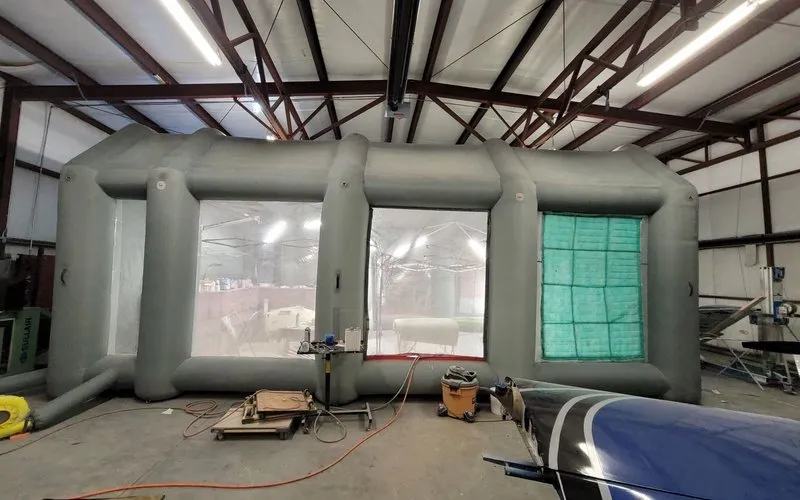
Sewinfla engineered a custom 60×30×22 ft inflatable booth that could be deployed inside the hangar on an as-needed basis, then deflated and rolled up against the back wall to free the floor space for storage between projects. Five engineering decisions drove the design:
1. Sizing for Wingtip Clearance
The booth was sized to fit a Beechcraft Bonanza A36 (33.5 ft wingspan, 11.5 ft height to top of vertical stabilizer) with 2 ft clearance on each wingtip and 1.5 ft overhead clearance for painting access. This let Client A service 95% of the general aviation fleet without disassembly. Twin-engine Cessna 310s and Piper Navajos (36.5 ft wingspan) fit with wings level and tail cone removed — a partial-disassembly savings of $1,800 per twin-engine job.
2. Negative-Pressure Mode
Aircraft refinishing requires negative-pressure booth operation to prevent paint particulate and solvent vapor from escaping into the surrounding hangar (where other customer's aircraft are stored). The booth was configured with dual 950 CFM blowers pulling air through the filter stages and exhausting via a 12-inch duct port routed through the hangar wall to outside. OSHA 1910.107(b)(5)(i) sets the reference at 100 linear ft/min average velocity over the open face or across the booth cross-section during spraying. The dual-blower package moves 1,900 CFM total; 1,900 CFM crosses 19 sq ft of face at that velocity (1,900 ÷ 100 = 19), so the exhaust face area is the figure to hold on any installation.
3. Hangar-Floor Anchoring System
Standard booth anchors (ground stakes) don't work on a hangar concrete floor. Sewinfla specified a removable anchor system using 4× 25-lb steel plate bases per corner, with quick-release straps. Setup time per anchor: 90 seconds. The plates store on a wall-mounted rack when the booth is deflated. Total anchor weight: 100 lbs per corner, 400 lbs total — manageable for two-person setup but sufficient to hold the booth against 25 mph hangar-door wind events.
4. Static-Dissipative Floor Section
Aircraft painting involves flammable solvents (toluene, MEK, acetone) at high vapor concentrations. The booth was equipped with a 12×8 ft static-dissipative floor section positioned under the aircraft work area, bonded to a hangar ground rod. This eliminates the static discharge risk that comes from rubber-soled shoes on the standard PVC drop cloth floor.
5. Lighting Spec for Color Match
Aircraft painting requires 6500K D65 color-corrected lighting for accurate color match — the FAA requires that all paint schemes match the type certificate data sheet exactly. Sewinfla installed 8× 150W IP65 LED panels at 6500K, providing 150+ foot-candles at the fuselage centerline. Lighting is positioned to minimize shadow on the wings and tail surfaces, which are the most visible paint areas.
Workflow Comparison: Before vs After
Workflow Before Sewinfla Booth
Single-Engine Aircraft (e.g., Cessna 182)
- Wing removal: 4 hours
- Tail removal: 2 hours
- Paint prep + spraying: 18 hours
- Cure + reassembly: 16 hours
- Total: 40 hours, $3,500 labor
Twin-Engine Aircraft (e.g., Cessna 310)
- Wing removal: 8 hours
- Tail removal: 3 hours
- Engine cowlings off: 4 hours
- Paint prep + spraying: 24 hours
- Cure + reassembly: 28 hours
- Total: 67 hours, $5,800 labor
Workflow With Sewinfla 60×30×22 Booth
Single-Engine Aircraft (e.g., Cessna 182)
- Disassembly: 0 hours (full aircraft fits)
- Paint prep + spraying: 14 hours
- Cure + reassembly: 0 hours (painted in final config)
- Total: 14 hours, $0 disassembly labor
Twin-Engine Aircraft (e.g., Cessna 310)
- Wing fold or tip removal: 2 hours
- Tail removal: 2 hours
- Paint prep + spraying: 20 hours
- Cure + reassembly: 4 hours
- Total: 28 hours, $1,800 labor
Ventilation Engineering for Aviation Coatings
Aviation coatings are chemically distinct from automotive. The two-coat system (epoxy primer + polyurethane topcoat) generates specific VOC profiles that require careful filter selection:
| Coating Stage | Primary Solvents | Filter Loading Concern | Replacement Trigger |
|---|---|---|---|
| Epoxy primer (chromated or non-chromated) | Xylene, MEK, toluene | Heavy VOC load, fast carbon saturation | Carbon filter: 60–80 spray hours |
| Polyurethane topcoat (Imron, Awlgrip) | Isocyanates, esters, glycol ethers | Isocyanate adsorption is critical for painter safety | Carbon filter: 80–100 spray hours |
| Clear coat (high-gloss) | Butyl acetate, aromatic hydrocarbons | Lower VOC load than base coat | Carbon filter: 100–120 spray hours |
| Stripper residue (chemical paint removal) | Methylene chloride, phenolic compounds | Pre-filter saturation from stripper aerosol | Pre-filter: 30–40 spray hours |
Isocyanates are the critical concern. They are respiratory sensitizers — a single overexposure can cause permanent asthma in susceptible painters. The activated-carbon filter stage is not optional for aviation work; it is the line between a safe working environment and a permanent occupational health issue. Sewinfla specified industrial-grade carbon (not consumer-grade) for this booth, with 50% carbon content by weight (vs. the 15–25% typical of consumer-grade filters).
The Build & Delivery
Custom specifications were confirmed on May 21, 2026. The booth shipped from the Sewinfla factory on June 4 — 14 days from order to delivery. Client A's 3-person ground crew completed first-time setup in 2 hours 45 minutes, including anchor installation, blower connection, static-dissipative floor placement, and lighting calibration.
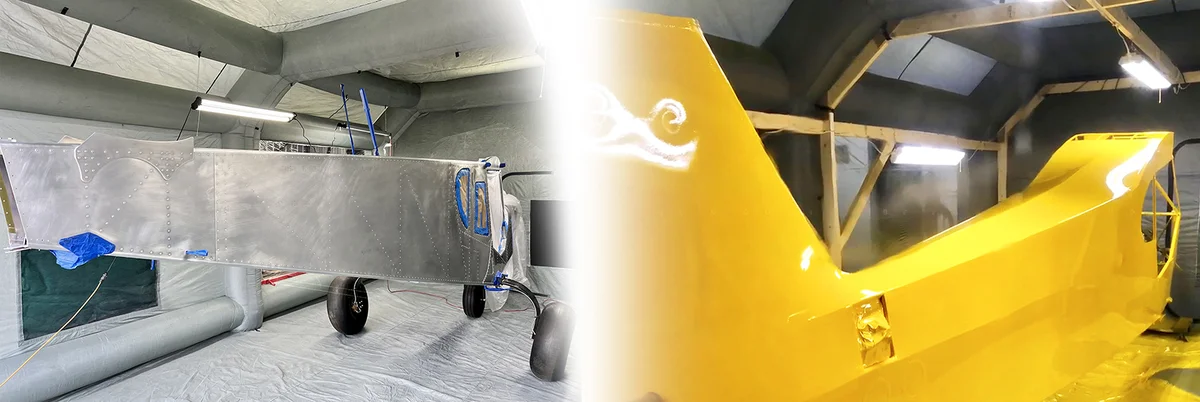
First production job: a 1968 Beechcraft Bonanza V-tail requiring complete strip-to-bare-metal refinish. The aircraft had not been painted in 22 years; the existing finish was heavily oxidized with multiple touch-up layers. The total booth usage for the project: 16 working days over four weeks, with intermittent cure time between coats. The aircraft was deflated and rolled up against the hangar wall during cure windows (4–6 hours between coats), allowing the operator to use the floor space for other work.
Year-One Economics
The operator completed 22 complete aircraft refinishes and 34 partial repaints in the first 12 months of booth operation:
| Cost / Revenue Item | Year 1 Total |
|---|---|
| Booth purchase (custom aviation spec) | $18,400 |
| Filter replacements (12 months active) | $3,240 |
| Electricity (estimated $0.14/kWh × 1,800 hrs) | $756 |
| Total first-year booth cost | $22,396 |
| Less: hangar floor cost avoided vs a permanent install (1,800 sq ft × $8/sq ft/yr) | −$14,400 |
| Net first-year booth cost | $7,996 |
| 22 complete × $14,500 avg refinish revenue | $319,000 |
| 34 partial × $3,200 avg partial revenue | $108,800 |
| Total booth-attributable revenue | $427,800 |
| Booth-attributable margin (38% of revenue) | $162,564 |
| Net first-year return | $154,568 (840% on the $18,400 booth) |
| Client-reported operating figures. The totals and percentages above are the arithmetic of the inputs listed, not audited accounts. | |
What Made This Project Different
Aircraft refinishing has unique requirements that drive specific booth design decisions. Three factors shaped the success of this deployment:
- Hangar-floor anchoring. Standard ground-stake anchors don't work on hangar concrete. The removable steel-plate anchor system allows 90-second setup and breakdown while providing sufficient holding force for the booth under all operational conditions.
- Static-dissipative floor. Flammable solvent vapors + rubber-soled shoes + standard PVC floor = static discharge risk. The 12×8 ft bonded static-dissipative floor section eliminates this risk without compromising the booth's portability.
- D65 color-corrected lighting. Aviation paint schemes must match type certificate data exactly. The 6500K D65 LED lighting allows the painter to verify color match against the manufacturer's color chip during application, not after cure.
Repurposing the Booth for the Off-Season
The Midwest general aviation market is seasonal — flying peaks May through October and slows November through April. During the slow season, the booth is deflated and stored, freeing 1,800 sq ft of hangar floor for cold-storage aircraft (revenue: $1.20/sq ft/month = $2,160/month or $12,960 over the 6-month off-season). A traditional fixed booth would have left this floor space permanently committed.
Additional off-season use: the booth was reconfigured (different anchor placement) and used for furniture refinishing — a side business the operator started in 2026 to diversify revenue. Furniture pieces don't require the full 60 ft length, so the booth was inflated to a partial length (30 ft) for these smaller jobs. This use case is not in Sewinfla's original spec but the modular design accommodated it without modification.
Build Process Highlights
- Day 1–4: Spec confirmation, CAD drawing review with Client A, aviation-specific hardware selection.
- Day 5–9: Material cutting, PVC welding, filter housing assembly, lighting harness installation.
- Day 10–12: Static-dissipative floor fabrication and bonding.
- Day 13: Quality control — 24-hour inflation test, lighting verification, zipper cycle test, seam inspection.
- Day 14: Packing and crating, pickup by Client A's freight carrier.
- Day 17: Delivery to Midwest hangar.
- Day 17: Setup by Client A's crew (with phone support from Sewinfla engineering team).
- Day 18: First paint job.
Continuing Support
Sewinfla provides ongoing support for custom booths including:
- Annual filter subscription: Scheduled delivery of pre-filter, carbon filter, and exhaust filter sets sized to the booth.
- Lighting replacement program: Pre-packaged LED panel kits for items that experience wear (every 5–7 years).
- Phone engineering support: Direct line to the engineering team that built the booth for troubleshooting.
- Reconfiguration services: If the operator needs to modify the booth (change dimensions, add a second door, upgrade filters), the original engineering team handles the modification.
What This Build Was Checked Against
An aircraft booth answers to two different rulebooks, and only one of them is a booth supplier's to design to. The workplace inside the enclosure is federal law — airflow, construction, clearance, grounding and filter disposal all sit in OSHA's spray-finishing rules. The finish system on the airframe is a separate question, answered by the aircraft's own maintenance documentation and accepted repair practice. This build was engineered against the first set, and deliberately kept out of the second.
- OSHA 1910.107(b)(5)(i) — the airflow figure the blower and filter bank were sized to. “The average air velocity over the open face of the booth (or booth cross section during spraying operations) shall be not less than 100 linear feet per minute.” A 60×30×22 ft envelope is 1,800 sq ft of cross-section and the clause is an average over that whole section — which is why the blower package and the filter bank were specified as a matched pair rather than as separate line items.
- OSHA 1910.107(b)(1) and (b)(2) — construction and interior surfaces. Booths must be “designed to sweep air currents toward the exhaust outlet”, with interiors “smooth and continuous without edges…to prevent pocketing of residues”. Directional sweep is what carries primer and topcoat overspray — and its isocyanate content — out of the painter's breathing zone instead of letting it recirculate; the continuous liner is why this enclosure has no exposed framing for primer dust to collect on.
- OSHA 1910.107(c)(9)(i) — grounding. “All metal parts of spray booths, exhaust ducts, and piping systems…shall be properly electrically grounded in an effective and permanent manner.” A hangar floor is an insulating slab, so bonding is part of the deployment rather than an accessory: the static-dissipative floor section, the blower frames and the exhaust ducting all bond back to the hangar's earth point.
- OSHA 1910.107(b)(8), (b)(9) and (c)(2) — what sits around it. Each booth must be separated from other operations by not less than 3 ft or by a partition; a clear space of not less than 3 ft on all sides must be kept free of storage or combustible construction; and electrical equipment within 20 ft of a spraying area, unless partitioned, must not produce sparks under normal operating conditions. Aircraft movement and hangar storage are exactly why the layout was fixed before production rather than on delivery day.
- OSHA 1910.107(b)(5)(ii) — what happens to the filter media afterwards. Discarded filter pads and rolls “shall be immediately removed to a safe, well-detached location…and disposed of at the close of the day's operation”. On a refinish this size the filter bank is a scheduled consumable with a disposal step, not a fit-and-forget part — see the replacement guide for the intervals this booth runs on.
- Isocyanates and OSHA 1910.134 — the health rule behind the carbon stage. Polyurethane topcoats (the Imron/Awlgrip class of products) are isocyanate-bearing. OSHA records that isocyanates “include compounds classified as potential human carcinogens” and that “the main effects of hazardous exposures are occupational asthma and other lung problems, as well as irritation of the eyes, nose, throat, and skin”. A respirator programme under 1910.134 is the primary control; the activated-carbon stage is a second layer, not a substitute for it.
- 40 CFR Part 63 Subpart GG — the aerospace coating standards, where they apply. Subpart GG carries separate standards for primer, topcoat and specialty coating application (§ 63.745) and for depainting (§ 63.746) — both stages this aircraft went through. Whether a given shop is a major source under Subpart GG or an area source under the 6H rule (40 CFR § 63.11173) is a determination for your state air-quality agency. It is not a determination a booth supplier makes, and we do not make it.
- FAA AC 43.13-1B — the half we do not answer. Accepted finishing and repair practice for the airframe — the circular's “Safety Tips for Dope/Paint” and “Coating Application Defects” material — together with the aircraft's own maintenance manual, governs whether a finish system is acceptable. The booth controls where the painter works; it has nothing to do with airworthiness documentation, and nothing on this page should be read as a statement about it.
Sources checked 27 September 2026: OSHA 29 CFR 1910.107 (construction, airflow, grounding, clearance, filter-media disposal); OSHA 29 CFR 1910.106 (flammable liquid storage); OSHA Isocyanates; OSHA 29 CFR 1910.134 (respiratory protection); Cornell LII 40 CFR Part 63 Subpart GG; FAA AC 43.13-1B.
Ready for a Custom Aviation Booth?
If you're refinishing aircraft in a hangar environment and need a custom booth specification, contact our engineering team for a sizing consultation. We'll review your typical aircraft dimensions, hangar layout, and coating chemistry, and provide a fixed-price quote within 48 hours.
Request Custom Engineering Quote →
⚠ Disclaimer: Custom booth specifications vary based on aircraft dimensions, hangar constraints, and coating chemistry. The figures in this case study reflect Client A's specific application and should not be interpreted as guaranteed performance for other installations. Booth dimensions are approximate; as a handmade inflatable product, actual measurements may vary based on air pressure, inflation level, and standing conditions. The physical product received shall prevail.
DIMENSIONS ARE APPROXIMATE. Each Sewinfla booth is a handmade inflatable product; measured dimensions vary with air pressure and standing conditions. The physical product as received prevails over any published figure.