The Positive Pressure Principle
An inflatable paint booth operates on a simple but powerful principle: positive pressure. A high-CFM blower forces filtered air into the booth chamber faster than it can escape through the exhaust vents. This creates internal pressure approximately 0.3–0.5 inches of water column (inWC) above ambient — enough to keep the fabric walls rigid and, critically, to prevent unfiltered outside air from entering through any small gaps or seams.
Positive pressure is the fundamental advantage over downdraft or crossdraft rigid booths. In a rigid booth with negative pressure (exhaust fan pulling air out), any leak in the structure draws in dirty outside air. With positive pressure, contaminated air is pushed out of leaks, not pulled in. This is why inflatable booths consistently produce fewer dust nibs than budget rigid booths — the physics works in your favor.
You can verify positive pressure with the "tissue test": hold a single-ply tissue near a seam or zipper from outside the booth. If the tissue is pushed away from the booth, you have positive pressure. If it's sucked toward the booth, your exhaust is overpowering your intake — increase blower speed or reduce exhaust opening.
Carbon Filter Structure: Two-Stage Filtration
Sewinfla inflatable booths use a two-stage filtration system that meets industrial standards for paint spray environments. The dual-filter design is not marketing — each stage performs a distinct chemical and mechanical function.
Stage 1: Fiberglass Pre-Filter
The intake side of the blower system is fitted with a high-loft fiberglass pre-filter, typically rated MERV 8–10. This filter captures large particulate matter — paint overspray droplets, sanding dust, pollen, and insect debris — before they can reach the main filter or enter the booth. The fiberglass matrix uses progressive density: looser fibers on the entry face capture 10–50 micron particles, while denser fibers deeper in the media capture 3–10 micron particles.
Pre-filters are sacrificial — they load up with overspray and must be replaced regularly (typically every 3–5 full spray jobs or when visibly loaded). A clogged pre-filter starves the blower of air, reducing booth pressure and compromising positive pressure. Keep spares on hand; they're inexpensive insurance.
Stage 2: Activated Carbon Filter
The activated carbon filter is where the chemistry happens. Activated carbon is charcoal that has been processed to create millions of microscopic pores, giving it an enormous surface area — one gram of activated carbon has over 500 m² of surface area. This porous structure adsorbs (not absorbs — adsorption is surface-binding, not soaking in) volatile organic compounds (VOCs) from the paint solvents.
As solvent-laden air passes through the carbon bed, VOC molecules physically bind to the carbon pore surfaces through van der Waals forces. This captures: toluene, xylene, acetone, MEK, isocyanates (from 2K clears), and other solvent vapors. The result is exhaust air that's dramatically cleaner than unfiltered spray environments — crucial for painters working in residential areas or attached garages where solvent odors are a concern.
The carbon filter has a finite service life determined by the total mass of solvent it can adsorb. Saturation is indicated when solvent odors become detectable at the exhaust. For a typical automotive paint job using 2 quarts of solvent-based products, a quality carbon filter lasts 8–12 full spray sessions before replacement.
What the filter stack is actually required to do — the published floor
Two published numbers set the legal floor for a paint booth's ventilation and filtration: an average of 100 linear feet per minute of air velocity across the booth opening, and filter media demonstrated to capture at least 98 percent of paint overspray. Everything else in a booth's design — blower wattage, duct length, filter depth — is engineering that has to deliver on those two figures.
- Velocity floor — 1910.107(b)(5)(i): spraying operations "shall be so designed, installed and maintained that the average air velocity over the open face of the booth (or booth cross section during spraying operations) shall be not less than 100 linear feet per minute." Electrostatic spraying may run at 60 linear ft/min or more, depending on the volume of finishing material applied. The same paragraph requires visible gauges and an audible alarm or pressure-activated device to indicate that the required velocity is being maintained — the regulatory reason a differential-pressure gauge belongs on an inflatable booth and not only on a fixed one.
- Filters must not shrink the working envelope — 1910.107(b)(5)(iii): "The location of filters in a spray booth shall be so as to not reduce the effective booth enclosure of the articles being sprayed." In practice this is the difference between a filter wall that sits outside the usable spray volume and one whose housing and framing eat into the depth you measured before buying.
- The filter plenum is a fire-protection concern — 1910.107(b)(5)(iv): space within the booth on the downstream and upstream sides of filters shall be protected with approved automatic sprinklers. That is the reason filtration is treated as part of the structure's fire plan rather than as a consumable bolted to the back wall.
- Some coatings and dry filtration do not mix — 1910.107(b)(5)(v): "Filters or filter rolls shall not be used when applying a spray material known to be highly susceptible to spontaneous heating and ignition." Most refinishing materials are not in that category, but the clause is why filter selection should follow the coating data sheet, not precede it.
- Clean filters must be noncombustible — 1910.107(b)(5)(vi): a requirement on the media itself, independent of its capture efficiency. Capture rating and fire behaviour are two separate properties that a product spec sheet should state separately.
- Frontal area geometry — 1910.107(b)(6): each spray booth having a frontal area larger than 9 square feet shall have a metal deflector or curtain not less than 2½ inches deep installed at the upper outer edge of the booth over the opening. Every inflatable booth exceeds 9 sq ft of frontal area by an order of magnitude, so that overhang at the top of the door is a required component, not a design flourish.
- Capture floor — 40 CFR 63.11173(e)(2)(i): spray booths "must be fitted with a type of filter technology that is demonstrated to achieve at least 98 percent capture of paint overspray," with the demonstration procedure "consistent with the ANSI/ASHRAE Standard 52.2-2017" and the filter challenged with 100 grams of loading dust, weighed to the nearest 0.1 gram (ASHRAE standards library). This is the numeric basis for treating filter loading as a performance limit rather than a maintenance preference: capture efficiency is a measured property, and it drops as the media loads.
Sources checked 2026-09-22: OSHA 29 CFR 1910.107; Cornell LII 40 CFR Part 63 Subpart HHHHHH and § 63.11173; ASHRAE standards library (ANSI/ASHRAE 52.2). Clause text quoted from the published regulation; no secondary summary was used.
Airflow Diagram Concept: The Complete Circuit
Air travels through the complete booth system in a one-directional circuit:
- Intake: Ambient air enters through the blower's intake grille, passing first through the fiberglass pre-filter.
- Pressurization: The blower forces filtered air through the inflation duct into the booth chamber, inflating the fabric structure to its full volume.
- Distribution: Air circulates through the booth, carrying overspray particles and solvent vapors toward the exhaust vents. Baffles or distribution tubes ensure airflow reaches all areas — no dead zones where overspray accumulates.
- Exhaust Filtration: Air exits through the exhaust ports, passing through the activated carbon filter that captures solvent VOCs before the air is released to the outside.
- Continuous Exchange: The blower runs continuously during spraying, exchanging the full air volume of the booth every 2–4 minutes depending on booth size and blower CFM rating.
Position the blower intake upwind of the exhaust. If your exhaust is downwind and blows solvent-laden air back toward the intake, you're recycling contaminated air and saturating your filters prematurely. A 20-foot separation between intake and exhaust sides eliminates recirculation.
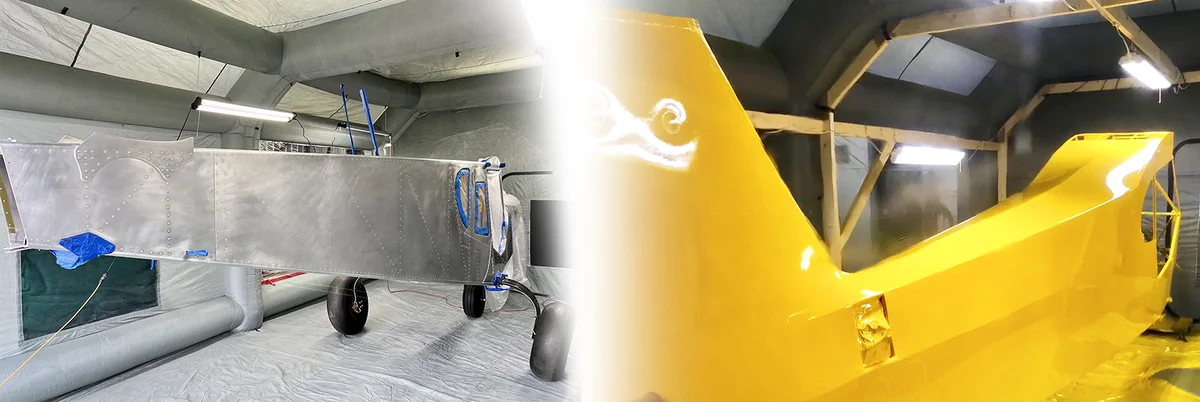
Booth Pressure Dynamics During Spraying
During spraying, the booth pressure fluctuates. When you open a zipper door to enter, pressure drops momentarily — but the blower's continuous delivery quickly re-pressurizes the chamber (typically within 3–5 seconds of closing the zipper). This rapid recovery is why positive pressure booths can handle entry/exit without contamination ingress: the brief pressure drop is too short for significant dirty air infiltration.
The exhaust vent design is equally important. Sewinfla booths use filtered exhaust ports that create backpressure — without it, the blower would simply blow air straight through and the booth wouldn't maintain inflation. The exhaust filter media provides this backpressure while simultaneously capturing overspray solids and solvent vapors. It's an elegant system: the same filter that cleans the exhaust also provides the flow restriction needed for inflation.
Key Takeaways
- Positive pressure (0.3–0.5 inWC) keeps unfiltered outside air out — verify with the tissue test
- Fiberglass pre-filter (MERV 8–10) captures overspray particulates; replace every 3–5 jobs
- Activated carbon filter adsorbs VOCs (toluene, xylene, isocyanates); lasts 8–12 spray sessions
- Complete air exchange every 2–4 minutes during operation ensures fresh air and visibility
- Intake/exhaust separation prevents solvent recirculation; 20-foot minimum spacing recommended
- Exhaust filter provides dual function: VOC capture + flow restriction for booth inflation
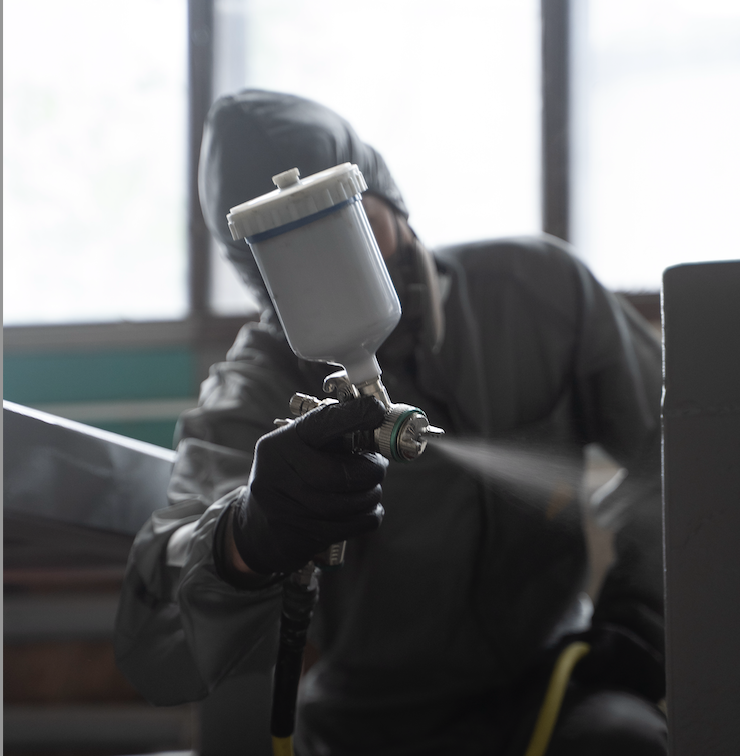
Industrial-Grade Filtration Built In
Every Sewinfla booth includes dual-stage activated-carbon filtration — fiberglass pre-filter + activated carbon. Breathe easier and spray cleaner.
Learn MoreRelated Guides
- Ventilation Design: Exhaust Fans & Airflow Optimization — intake and exhaust geometry for dead-zone-free booths.
- 210D vs 420D vs PVC: Material Comparison — what each fabric property is and how it is measured.
- Inflatable Paint Booth CFM Calculator — airflow maths, derate factors and blower selection.
- Inflatable Paint Booth Maintenance — cleaning cadence, fabric repair and storage.
- How to Paint a Car in an Inflatable Paint Booth — the full walk-around respray workflow, from sizing to spray order.