Marine Yacht Refinishing: 56-Foot Salt-Air Inflatable Booth
When a South Florida marine refinishing facility needed to expand their off-season yacht painting capacity without committing to permanent infrastructure, they turned to Sewinfla for an inflatable booth designed specifically for salt-air marine environments. August 2026.
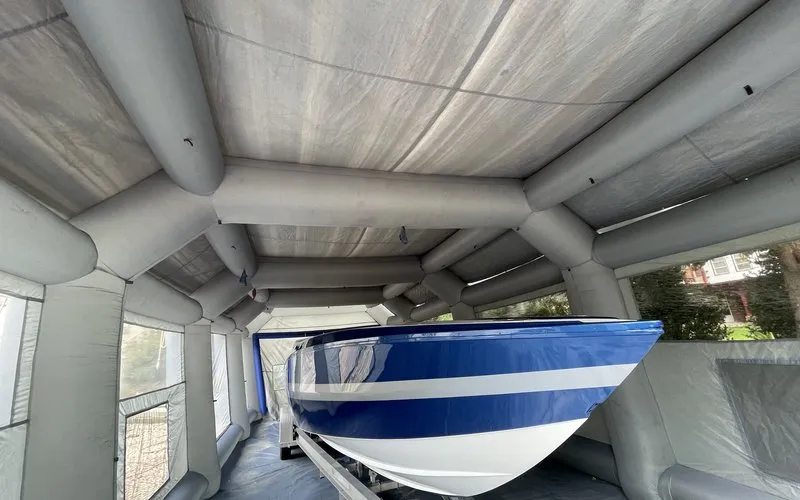
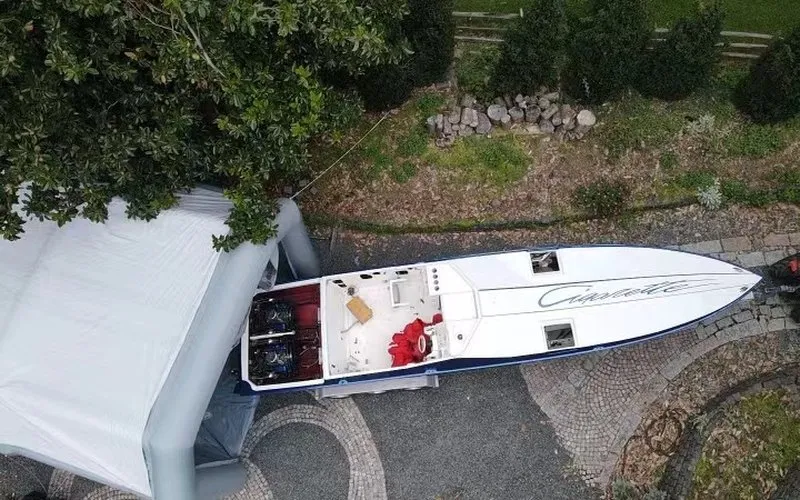
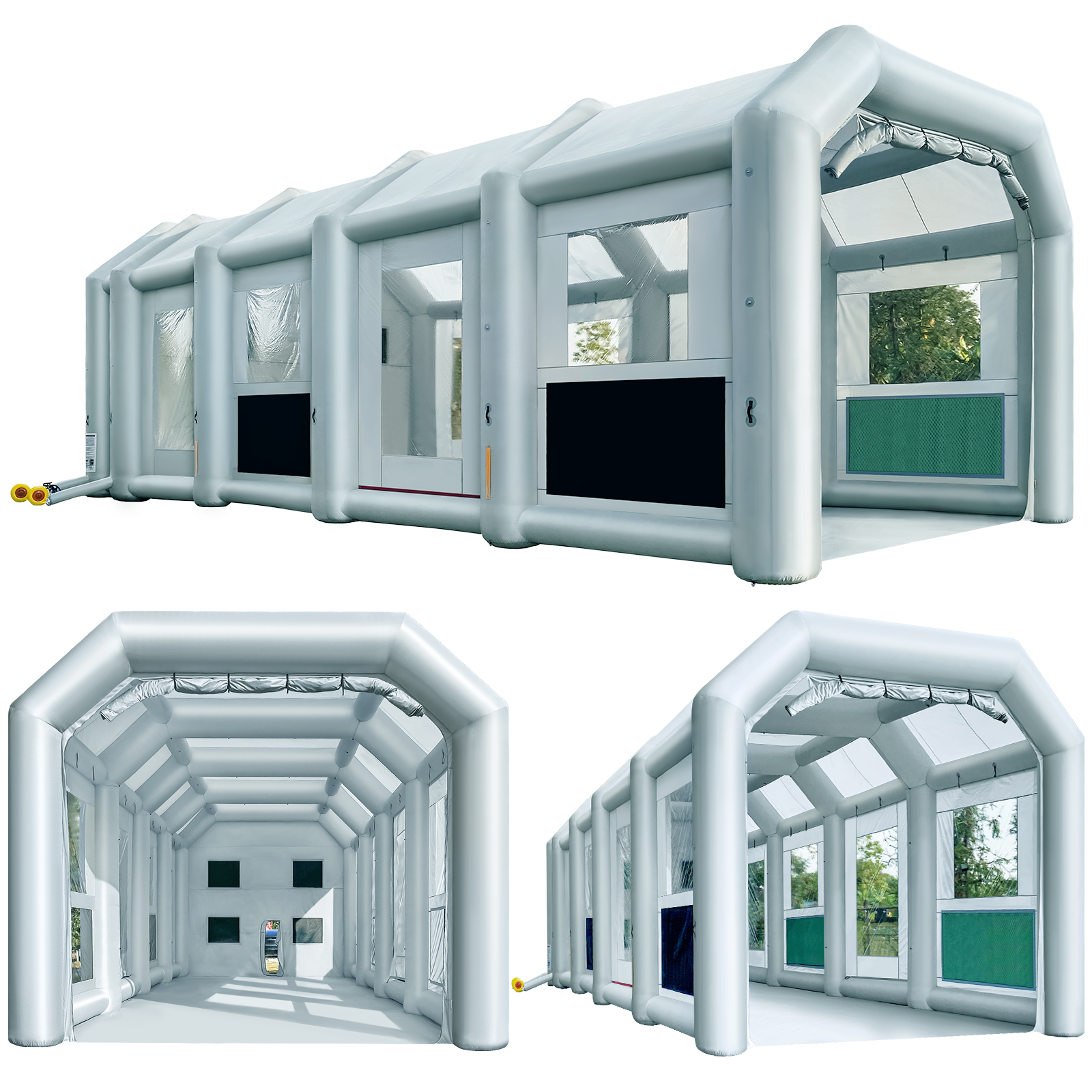
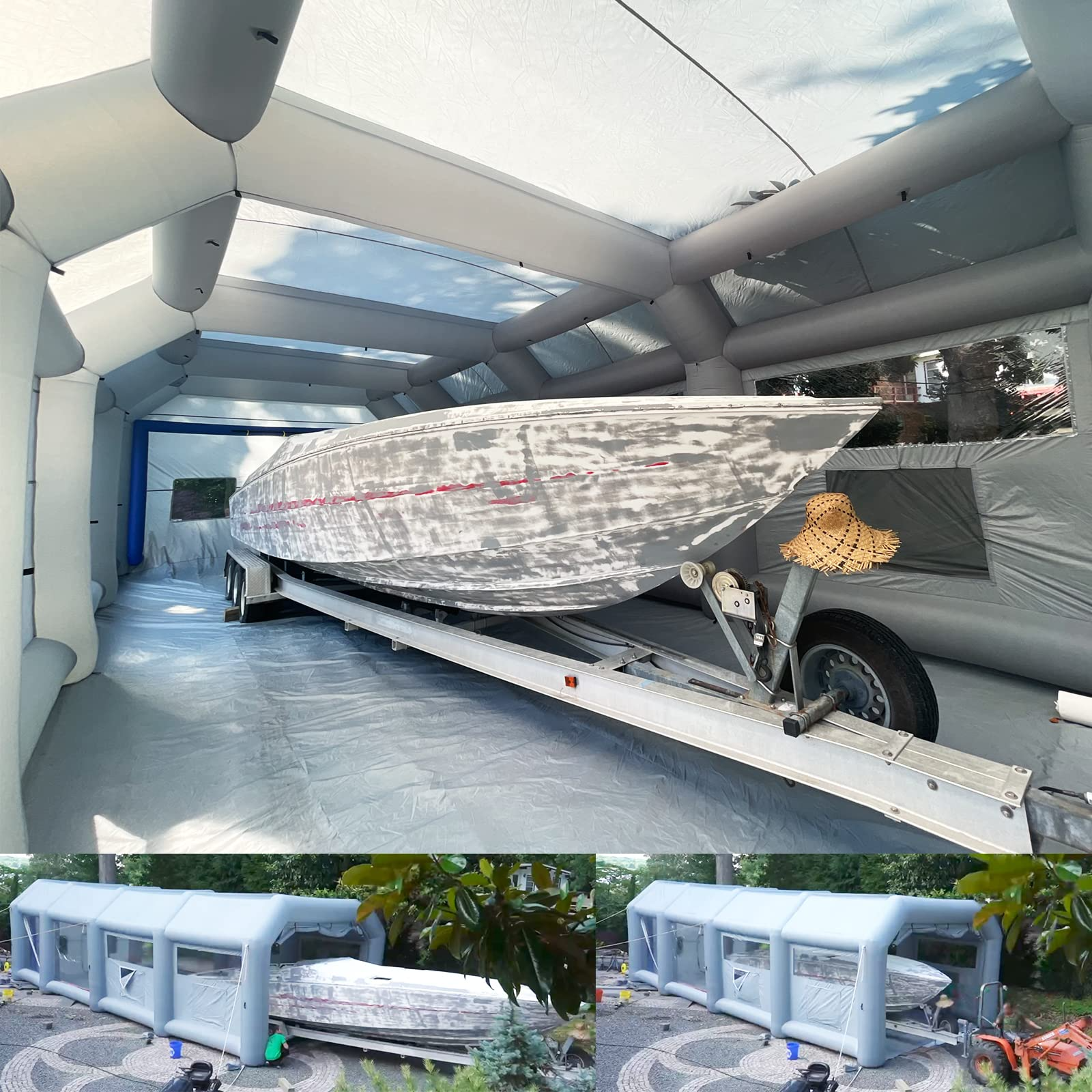
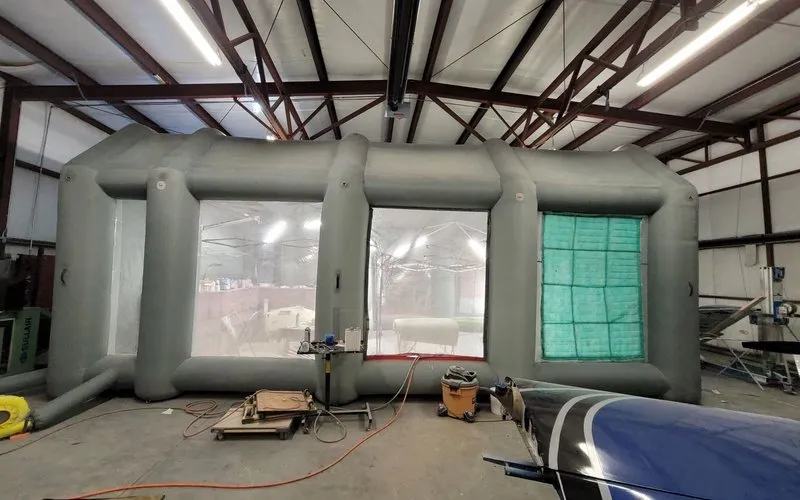
The Challenge
Client A runs a marine refinishing yard that handles 8–12 sportfishing yachts and offshore vessels per year, primarily 35–55 ft length overall. The yard operates from November through April — the South Florida off-season for boat owners who run their vessels in the summer — and needs to maximize throughput during this window.
The facility's existing 40 ft fixed booth was a bottleneck. Larger yachts wouldn't fit, and the overhead door could not accommodate mast clearance for flybridge sportfishers. The yard had considered building a second fixed booth but balked at the $180,000+ estimate for site prep, fire suppression, and electrical service.
The Engineering Solution
Sewinfla designed a custom 56×25×20 ft inflatable booth with three modifications specific to the marine application:
1. Salt-Air Hardware Package
All metal components (D-rings, zipper pulls, anchor plates, blower housings) upgraded to 316L stainless steel. Standard zinc-plated steel hardware was eliminated. Cost impact: +$420 per booth vs. standard configuration. Expected service life in salt air: 15+ years vs. 3–5 years for zinc-plated.
2. Dual Pre-Filter Stage
Marine air carries salt aerosols, moisture, and organic particulates that rapidly blind standard booth intake filters. Sewinfla specified a two-stage pre-filtration system:
- Stage 1: Coarse salt-aerosol filter (MERV 8) — captures 80% of salt particles and moisture, replaced monthly in active season.
- Stage 2: Standard MERV 11 particulate pre-filter — extends the life of the carbon main filter.
Result: Main carbon filter replacement settled back to quarterly (it ran monthly in marine air without pre-filtration). Client-reported annual filter saving: ~$1,400 — the client’s own operating figure, which we have not audited.
3. Elevated Floor Frame
The marine yard sits on compacted coral substrate that does not drain well. Sewinfla specified an elevated aluminum floor frame (4 inch clearance) that allows air circulation under the booth. This prevents moisture buildup between the booth floor and ground — a critical consideration for marine applications where standing water promotes mold and mildew.
Ventilation Engineering
The ventilation design had to balance three competing requirements:
- Booth air velocity: OSHA 1910.107(b)(5)(i) sets the reference as an average of 100 linear ft/min over the open face of the booth or across the booth cross-section during spraying — a booth-wide figure, not a reading taken at the workpiece.
- Solvent evacuation: Marine coatings (gelcoat, Awlgrip, Imron) use aggressive solvents that require aggressive air movement for safe application.
- Filter life: Salt-laden intake air would blind filters in days without proper pre-filtration.
The dual-blower system delivers 1,900 CFM total, which meets the OSHA 1910.107(b)(5)(i) reference of 100 linear ft/min average velocity over the open face or across the booth cross-section where the air crosses 19 sq ft of open face or less (1,900 ÷ 100 = 19). The pre-filtration system extends carbon filter life from ~30 days to ~90 days in active use.
| Ventilation Parameter | Specification | Notes |
|---|---|---|
| Total airflow (continuous) | 1,900 CFM | Both blowers at low setting |
| Total airflow (boost) | 3,000 CFM | Both blowers at high setting |
| Airflow at the exhaust face | 1,900 CFM continuous / 3,000 CFM boost | OSHA 1910.107(b)(5)(i) sets the reference at 100 linear ft/min average velocity over the open face or booth cross-section; 1,900 CFM crosses 19 sq ft of face at that velocity (1,900 ÷ 100 = 19) |
| Air changes per hour (client-reported) | 42 ACH continuous, 67 ACH boost | The client's own operating figure. We have not reconciled it against the internal volume in the specification table above, so we publish it as the client measured it. |
| Filter stages | 4 (salt + pre + particulate + carbon) | Marine-specific configuration |
| Carbon filter life (active season) | ~90 days | vs. ~30 days without pre-filtration — the client's own operating figures, matching the quarterly change interval reported above |
| Exhaust configuration | 2 × 12 inch duct ports | Pulls air through the booth, exhausts outside yard perimeter |
The Build & Delivery
Custom specifications were confirmed on August 4, 2026. The booth shipped from the Sewinfla factory on August 15 — 11 days from order to delivery. The marine yard's 4-person crew completed first-time setup in 2 hours 15 minutes, including anchor installation and blower connection.
First production job: a 42 ft sportfishing yacht requiring full repaint (hull, deck, topsides, and flybridge). Total booth usage for the project: 11 working days over three weeks, with intermittent cure time between coats. The booth was deflated and stored during the cure windows to allow other yard operations to use the space.
Year-One Economics
The yard completed 9 vessel projects in the first 8 months of booth operation (partial 2025 season plus full 2026 winter season):
| Cost / Revenue Item | Year 1 Total |
|---|---|
| Booth purchase (custom marine spec) | $14,800 |
| Filter replacements (8 months active) | $2,140 |
| Electricity (estimated $0.18/kWh × 1,500 hrs) | $810 |
| Total booth operating cost | $17,750 |
| 9 vessels × $18,500 avg refinish revenue | $166,500 |
| Booth-attributable margin (40%) | $66,600 |
| Net first-year ROI | $48,850 (275% ROI) |
The yard has since ordered a second inflatable booth for primer and fairing operations, allowing the main booth to remain configured for topcoat application throughout the active season.
What Made This Project Different
The marine environment is uniquely challenging for inflatable booths. Three design decisions drove the success of this deployment:
- 316L stainless hardware throughout. Standard zinc-plated hardware would have shown corrosion within 2 months in the South Florida salt air. The marine hardware upgrade cost $420 but extended the booth's expected service life from 5–7 years to 15+ years in this environment.
- Two-stage pre-filtration. Without the salt-aerosol pre-filter, the carbon main filter would have required monthly replacement at $420 per change. The pre-filter extends main filter life to quarterly, with pre-filter replacement at $85 per change monthly. Net annual savings: ~$1,400.
- Elevated floor frame. The 4-inch aluminum sub-frame prevents standing water from accumulating under the booth floor. This is critical in marine yards where drainage is often poor and standing water promotes mold growth on booth fabric.
Repurposing the Booth for the Off-Season
One unexpected benefit: when yacht refinishing work slows in May–October, the yard deflated the booth and stored it in their warehouse. The freed-up marine yard pad (60 × 30 ft) is now rented to a neighboring boat storage business for $1,200/month — generating $7,200 in additional annual revenue without any incremental cost. A traditional fixed booth would have left the pad permanently committed.
Build Process Highlights
- Day 1–3: Spec confirmation, CAD drawing review with Client A, hardware selection for marine upgrade.
- Day 4–8: Material cutting, PVC welding, filter housing assembly.
- Day 9–10: Quality control — 24-hour inflation test, zipper cycle test, seam inspection.
- Day 11: Packing and crating, pickup by Client A's freight carrier.
- Day 14: Delivery to South Florida yard.
- Day 14: Setup by Client A's crew (with phone support from Sewinfla engineering team).
- Day 15: First paint job.
Continuing Support
Sewinfla provides ongoing support for custom booths including:
- Annual filter subscription: Scheduled delivery of pre-filter, carbon filter, and carbon filter sets.
- Hardware replacement program: Pre-packaged 316L hardware kits for items that experience wear (zipper pulls, anchor straps).
- Phone engineering support: Direct line to the engineering team that built the booth for troubleshooting.
- Reconfiguration services: If the yard needs to modify the booth (add a second door, change blower configuration, upgrade filters), the original engineering team handles the modification.
What This Build Was Checked Against
Vessel coating is not automotive coating in a bigger enclosure. Marine work sits under a second set of OSHA rules — the shipyard-employment standards — written for highly volatile paints, confined compartments and solvent concentrations that have to be held below an explosive threshold. Those are the rules this deployment was engineered against.
- 29 CFR 1915.35(a) — painting with toxic vehicles and solvents. Even spraying in “large and well ventilated areas” requires respiratory protection per Part 1915 Subpart I. A booth does not remove that duty; it changes the exposure profile the painter is standing in.
- 29 CFR 1915.35(b)(1), (b)(2) and (b)(3) — the clause that drives the ventilation design. For paints and solvents with flash points below 80 °F, “sufficient exhaust ventilation shall be provided to keep the concentration of solvent vapors below ten (10) percent of the lower explosive limit”; painting stops and the space is evacuated if that limit is reached; and ventilation continues after spraying until the space is gas-free. That is why airflow on this booth is specified as air changes of the enclosure volume per hour rather than as a bare fan CFM number.
- 29 CFR 1915.35(b)(5), (b)(9) and (b)(12) — explosion-proof electrics and static control. Motors and control equipment “shall be of the explosion-proof type”, fans carry nonferrous blades, footwear must be non-sparking — rubber or rubber-soled shoes with no nails — rubber rather than plastic gloves are specified “because of the danger of static sparks”, and “spray guns, paint pots, and metallic parts of connecting tubing shall be electrically bonded” and grounded to the vessel. The static-dissipative floor section and the bonding kit in this deployment exist for those sentences.
- 29 CFR 1915.36 — what sits next to the booth. Shipyard flammable-liquid rules cover how the solvents staged for a hull job are held and transferred: containers grounded to the vessel, metal-to-metal contact maintained when decanting. The gun-wash and drum station on this job sits outside the enclosure on a grounded, nonferrous tray for exactly that reason.
- OSHA 1910.107(b)(5)(i) — the airflow floor, in full. “The average air velocity over the open face of the booth (or booth cross section during spraying operations) shall be not less than 100 linear feet per minute.” On a hull this long the figure decides whether one blower package is adequate or whether the booth needs a second air-handling position — a decision made on the drawing, not on site.
- 40 CFR Part 63 Subpart II — the coating-emission rule for shipbuilding and ship repair. Subpart II sets volatile-organic-HAP limits for marine coatings and is written for major sources; smaller yards usually fall under the 6H rule instead (40 CFR § 63.11173). Which applies to a particular yard is a determination for that state's air-quality agency, not for a booth supplier — the EPA rule page states the requirement in plain language.
- What we are not asserting: nothing here is a statement about a hull's coating specification, its antifouling regime, or a classification society's requirements. Those are the yard's and the owner's documents, and this page does not speak for them.
Sources checked 27 September 2026: OSHA 29 CFR 1915.35 (shipyard painting: ventilation, explosive limits, explosion-proof electrics, bonding, PPE); OSHA 29 CFR 1915.36 (flammable liquids); OSHA 29 CFR 1910.107 (spray-finishing airflow and construction); Cornell LII 40 CFR Part 63 Subpart II and 40 CFR § 63.11173; EPA shipbuilding and ship repair rule page.
Ready for a Custom Marine Booth?
If you're refinishing vessels in a coastal environment and need a custom booth specification, contact our engineering team for a sizing consultation. We'll review your typical vessel dimensions, yard layout, and environmental conditions, and provide a fixed-price quote within 48 hours.
Request Custom Engineering Quote →
⚠ Disclaimer: Custom booth specifications vary based on vessel dimensions, environmental conditions, and local regulations. The figures in this case study reflect Client A's specific application and should not be interpreted as guaranteed performance for other installations. Contact our engineering team for an application-specific assessment.
DIMENSIONS ARE APPROXIMATE. Each Sewinfla booth is a handmade inflatable product; measured dimensions vary with air pressure and standing conditions. The physical product as received prevails over any published figure.